What Makes API Documentation Work?


Some APIs can be easily understood from the moment you open their documentation, while others will leave you hovering from one page to another to get started. The key difference is rarely about the API but the quality of documentation created for it. By studying the documentation practices of companies like Stripe, Twilio, GitHub, Spotify, and X, there are several characteristics that show up consistently. Let’s take a look at some of them.
Clear getting started guides
For developers, their experience in the first few minutes of opening the documentation shapes their outlook on the API. This often determines if they continue exploring how to use the API or move to a different alternative.
In effective documentation, there is a clear path from account creation to making your first successful API request. The focus is on helping developers achieve their first win rather than pushing technical details in their faces.
Stripe, for example, provides dedicated getting started resources, SDK installation instructions, testing guides, and integration tools that can help developers build things quickly.
A clear getting started guide should answer the following questions immediately:
- What does this API do?
- How do I authenticate?
- How do I make my first request?
- What should I expect in the response?
When developers find these answers within minutes, it becomes easier for them to adopt the API.
Practical code examples
For developers, they learn by doing. There is no amount of descriptive text that can replace a working code example. To create effective documentation, you should include examples that demonstrate real-world cases. The examples should be complete enough to copy, run, and modify.
A good example is Twilio’s documentation that includes multi-language code examples to help developers understand how to implement across different environments.
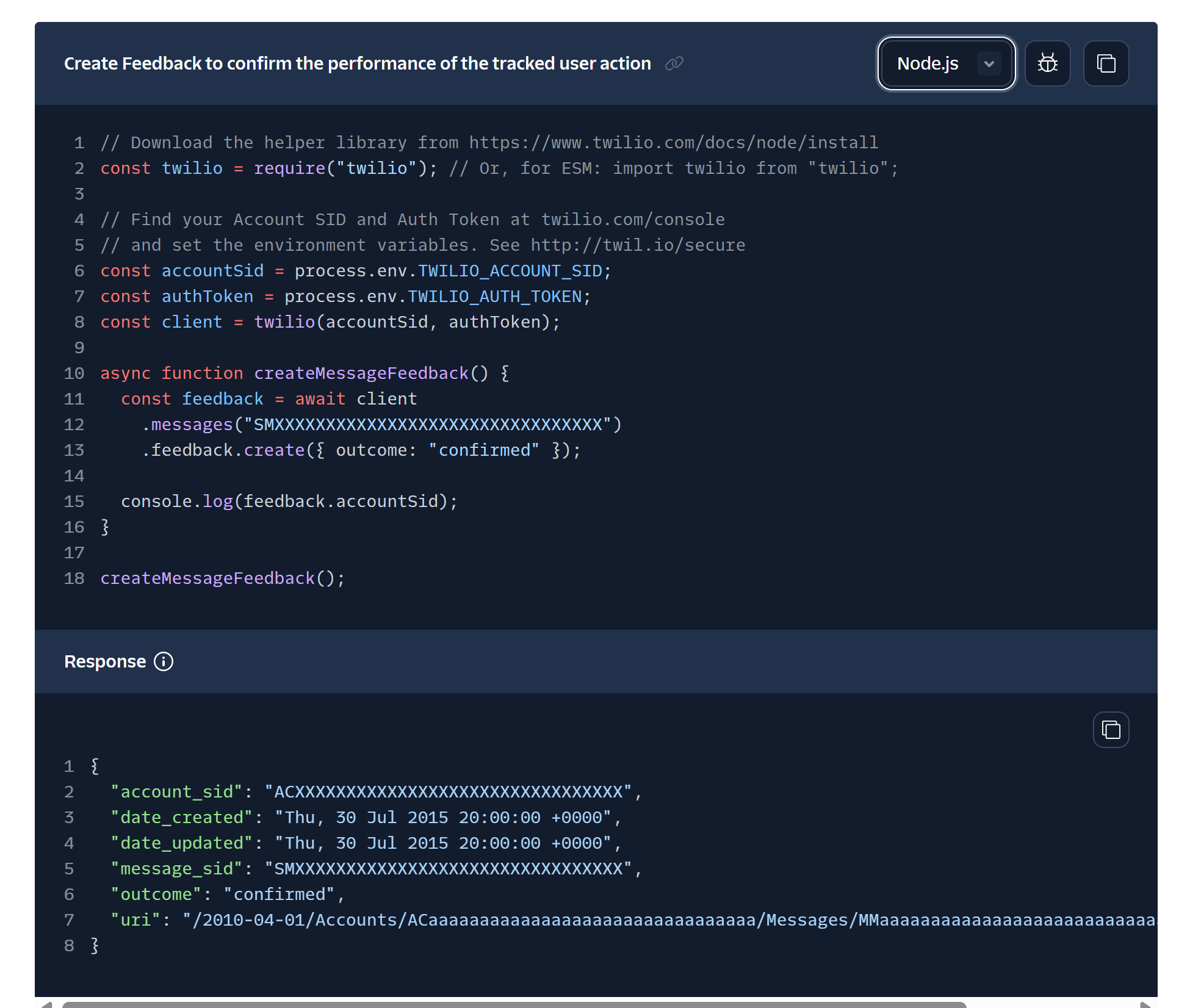
A multi-language code example in the Twilio API docs
Good examples normally:
- Use realistic data
- Show complete requests and responses
- Cover common workflows
- Include error-handling examples
Research on API documentation has also shown that developers place significant value on practical usage scenarios and examples when learning about new APIs.
Comprehensive API references
In API documentation, guides help developers get started, but with references, they can build production applications. A good API reference should clearly document:
- Endpoints
- Parameters
- Authentication requirements
- Request formats
- Response schemas
- Status codes
- Error messages
Stripe's API reference is a strong example of this approach. It provides predictable resource structures, request formats, authentication guidance, testing information, and error-handling documentation in a consistent format.
For these references, completeness matters because developers frequently rely on references while troubleshooting. When there are missing parameters or unclear error responses, it can lead to frustration.
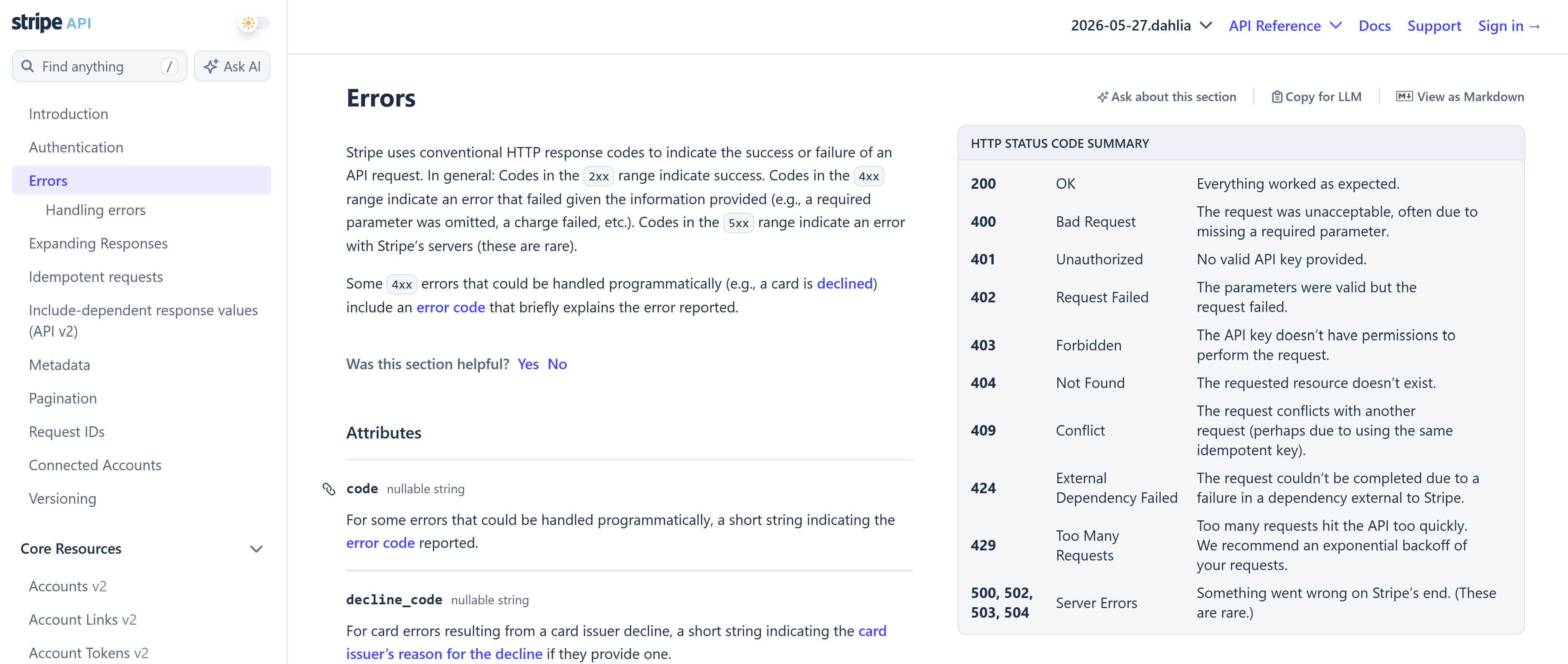
Error codes page in Stripe API docs
Excellent navigation and search
Even with the best content, if developers cannot find it, it becomes ineffective. Your documentation should be organized around the user’s goals rather than how the internal product is structured. The navigation should make it easy to move between tutorials, guides, API references, troubleshooting resources, and changelogs.
Developers can easily identify poor navigation in your documentation and weak search experiences. Good documentation sites should make it easy to answer questions such as:
- How do I authenticate?
- How do webhooks work?
- What causes this error?
- Has this endpoint changed recently?
How quickly the developers can find the answers they are looking for leads to the likelihood of trusting the documentation.
Documentation that stays current
Documentation should be viewed as a product that requires continuous maintenance.
Having outdated examples, deprecated SDK references, and inaccurate endpoint information will create confusion and increase support costs. Developers can judge how reliable an API is by the reliability of its documentation.
Top API providers invest heavily in versioning, changelogs, and regular documentation updates. Stripe, for example, maintains versioning guidance, API upgrade documentation, and changelogs to help developers manage these changes over time. This means that maintaining documentation should be part of the development lifecycle.
Using docs-as-code practices, automated reviews, and implementing documentation ownership models can help teams keep content accurate as the product evolves.
Conclusion
What makes API documentation work is its ability to help developers achieve their goals with minimal friction. Good documentation shares several characteristics: clear getting-started guides, practical examples, comprehensive references, excellent navigation, and consistent maintenance. Together, these characteristics transform the developer experience. When documentation helps the developers quickly, the API is easier to trust and adopt.